
What Local Businesses Are Really Asking About AI
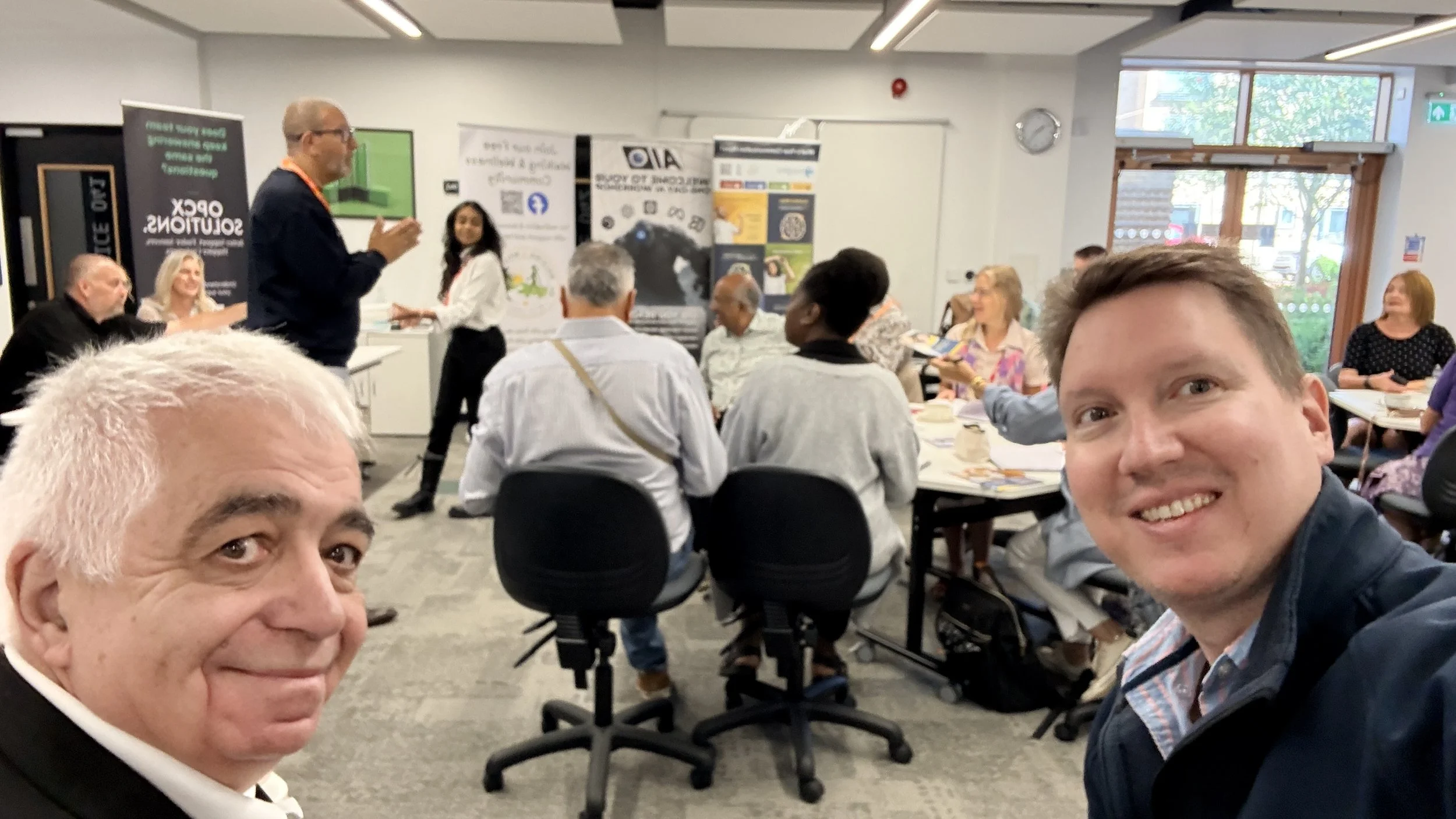
This week, we attended the AI Cyclops Business Club event at the South Central Institute of Technology in Bletchley.
Hosted by Andy Jones and the AI Cyclops team, the morning brought together businesses and entrepreneurs from across Milton Keynes for networking, practical demonstrations and conversations about artificial intelligence.
As with most good business events, the most valuable part was not a single presentation or technology demonstration. It was hearing the questions people were asking and discovering how differently organisations are approaching AI.
Some businesses are already using AI every day. Others have experimented with tools such as ChatGPT but have yet to connect them to a wider business objective. Many are interested in what AI could do, while remaining understandably uncertain about where to begin.
That range of experiences reflects the wider AI market. The technology is becoming increasingly accessible, but turning it into meaningful business value remains much harder.
What Are Businesses Using AI For?
For most small and medium-sized businesses, AI adoption does not begin with building sophisticated autonomous systems. It begins with finding practical ways to make everyday work faster, easier or more consistent.
That might involve researching a prospective customer before a meeting, summarising documents, drafting communications, analysing feedback or retrieving information from internal systems. AI can also support more complex workflows across marketing, sales, customer service and operations.
The number of potential applications is growing quickly. However, that abundance of choice can itself become a problem.
When businesses begin with the question, “Which AI tool should we use?”, they can easily end up purchasing technology before defining what it is expected to achieve.
A more useful question is: “Which business problem are we trying to solve?”
Successful AI Adoption Starts With the Business Problem
A clearly defined problem creates a much stronger foundation for AI adoption.
The objective might be to reduce the time employees spend on repetitive administration, improve the quality of customer information, shorten response times or make performance easier to understand. Once the desired outcome is clear, the business can examine the process surrounding it and decide whether AI is the right solution.
This distinction matters because not every operational problem requires artificial intelligence. Sometimes the answer is a clearer process, better information or more consistent management.
Technology should support a well-designed way of working. It should not be expected to create one.
AI Cannot Fix a Broken Process
One of the most important lessons for organisations considering AI is that automation tends to inherit the conditions around it.
If a process is unclear, automating it can make the confusion move faster. If customer information is unreliable, an AI system may produce unreliable answers more efficiently. If nobody owns a particular stage of a workflow, adding another tool will not resolve the underlying gap in accountability.
This is why businesses should understand how work currently happens before trying to automate it.
Where does the process begin? Who is responsible for each stage? Which systems contain the necessary information? Where do delays and exceptions occur? Which decisions can be supported by technology, and which still require human judgement?
These questions are less exciting than a demonstration of the latest AI product, but they are far more likely to determine whether an implementation succeeds.
From Individual Experiments to Business Capability
Many organisations are currently in an experimental phase. Employees are trying different tools, finding useful applications and learning what the technology can do.
That experimentation is valuable. It builds confidence and helps businesses discover opportunities that might not be obvious from the outside.
The next challenge is turning isolated examples into reliable organisational capability.
A useful personal workflow does not automatically become a scalable business process. For that to happen, the organisation needs appropriate data, clear ownership, agreed standards and a way to measure the result. It must also consider security, accuracy, governance and employee adoption.
The organisations that gain the most from AI will not necessarily be those that try the largest number of tools. They will be the ones that learn how to connect the technology to real work and measurable outcomes.
Why Local AI Events Matter
The AI Cyclops Business Club event provided a relaxed setting in which local businesses could explore these questions, see practical examples and speak with others at different stages of adoption.
Events like this play an important role because AI can otherwise feel abstract or inaccessible. Practical workshops and conversations help move the subject away from headlines and towards what it could mean for a real organisation.
They also create space for businesses to learn from one another. An application developed in one industry may inspire a useful idea in another, even if the eventual implementation looks very different.
For us, the morning reinforced that interest in AI is not confined to large technology companies. Businesses across Milton Keynes are actively exploring how it could support their people, improve their operations and create new opportunities.
The Most Important AI Question
AI technology will continue to develop quickly. New products will appear, existing tools will become more capable and some of today’s barriers will become easier to overcome.
But the central business question will remain the same:
Where can AI make a meaningful difference, and what needs to be in place for that difference to last?
Answering that question requires more than selecting software. It requires an understanding of the organisation, its customers, its processes and the outcomes it wants to achieve.
We would like to thank Andy Jones and the AI Cyclops team for organising the event, and everyone we met for the enjoyable and thought-provoking conversations.
Frequently Asked Questions
How can a small business start using AI?
A small business should begin with a specific, recurring problem rather than selecting an AI tool first. Identify work that consumes significant time, creates delays or depends on repetitive information processing. A small pilot can then be introduced and measured before it is expanded.
Which business processes can AI support?
AI can support research, document summarisation, customer communication, sales preparation, marketing production, knowledge retrieval, reporting and workflow administration. The right application depends on the business objective, available information and level of risk.
Can AI improve an inefficient business process?
AI may improve parts of an inefficient process, but it cannot resolve unclear ownership, poor-quality data or conflicting ways of working by itself. Businesses should understand and simplify the process before automating it.
What determines whether an AI project succeeds?
Successful AI projects normally have a clear business objective, a defined process, reliable information, accountable ownership, appropriate governance and measurable outcomes. Employee involvement and adoption are equally important.