
Why B2B Sales Opportunities Stall: Understanding the Buying Group
A proposal has been sent. The CRM looks promising. But has the customer actually moved closer to making a decision?
Executive Summary
B2B sales opportunities don't always stall because of poor selling, weak demand or an uncompetitive product.
Sometimes the sales process is progressing while the customer's buying process has barely begun.
A successful demonstration, an enthusiastic contact or a submitted proposal can create the impression of progress. Yet behind that initial relationship, other stakeholders may still be assessing the financial, operational and strategic implications of the purchase.
Research from Forrester shows that B2B buying groups are becoming increasingly complex, with more stakeholders involved in evaluating suppliers and reducing purchasing risk.
For growing businesses, this raises an important question: Does the sales process reflect how customers actually make decisions, or does it primarily measure what the sales team has done?
Understanding that distinction can improve qualification, customer engagement, CRM design, forecasting and commercial performance.
Key Takeaways
Sales activity and customer buying progress are not necessarily the same thing.
B2B purchasing decisions often involve stakeholders beyond the initial contact, each with different concerns and requirements.
CRM systems can provide detailed visibility of sales activity without revealing how close a customer is to making a decision.
Sales and Marketing play complementary roles in supporting the wider buying group.
Understanding the customer's decision-making process can improve qualification, forecasting and the allocation of commercial resources.
1. The Opportunity That Looked Promising
Consider a familiar situation.
A growing B2B technology business receives an enquiry from a prospective customer.
The customer appears to fit the company's ideal customer profile. They have a recognisable problem, sufficient organisational scale and a genuine interest in the solution.
An initial conversation goes well. A demonstration is arranged, attended and positively received.
Sales prepares a proposal, confirms the expected value of the opportunity and updates the CRM.
The deal moves into a later pipeline stage.
Then progress slows.
Follow-up emails receive polite responses. The contact remains interested but needs to discuss the proposal internally. Another meeting is postponed. A decision originally expected this month moves into the next quarter.
Eventually, the opportunity becomes difficult to forecast.
From the seller's perspective, much of the expected activity has been completed.
But what has happened inside the customer's organisation?
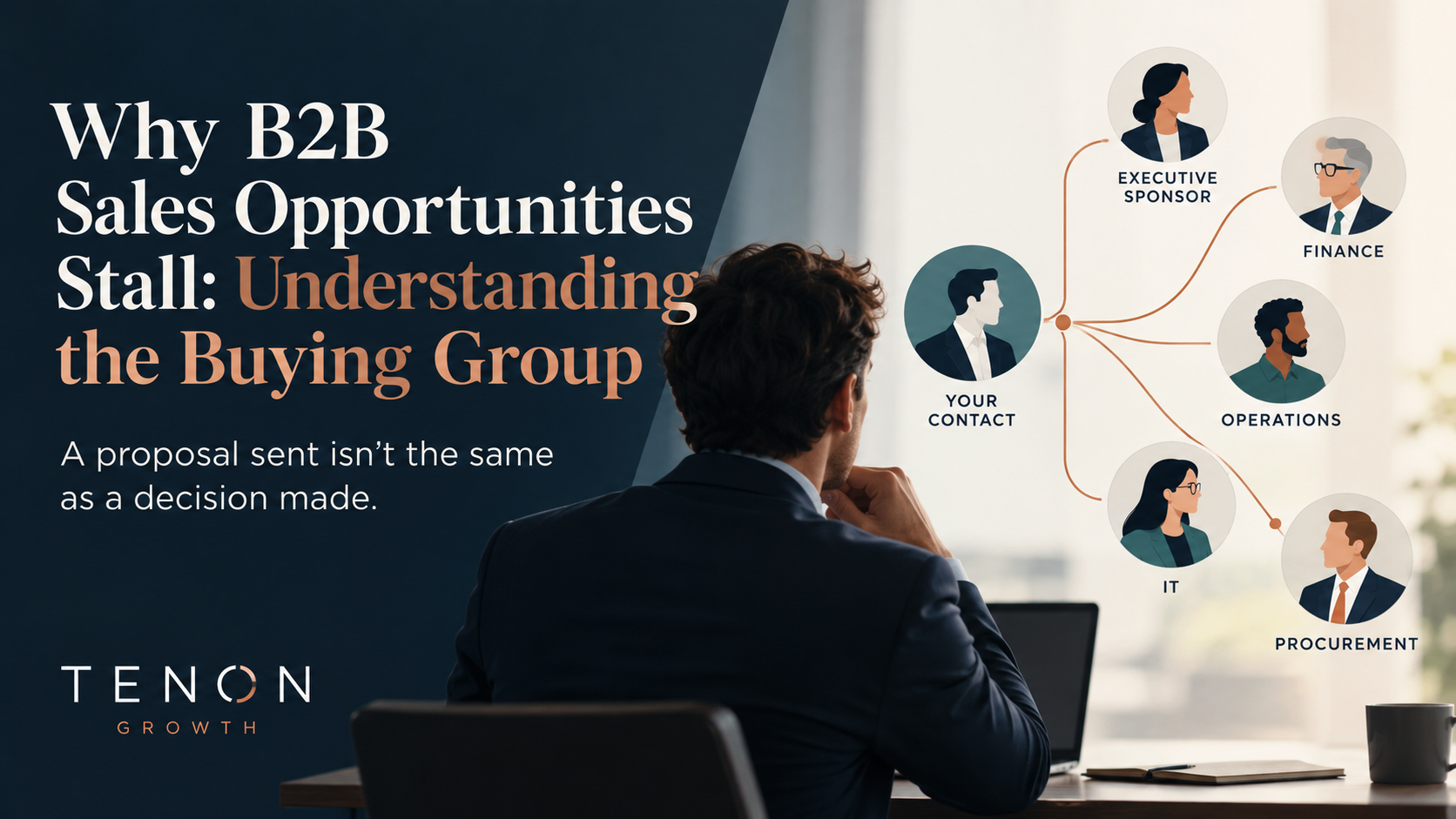
Perhaps Finance has concerns about the business case. Operations is uncertain about implementation. IT needs to assess integration requirements. A senior executive has other investment priorities.
The person who originally requested the demonstration may still support the purchase but lack the authority or internal agreement required to proceed.
The sales process has advanced further than the customer's buying decision.
This distinction matters because it suggests the problem may not be a lack of sales activity. It may be an incomplete understanding of how the customer makes purchasing decisions.
2. B2B Buying Is Becoming More Complex
The way organisations research, evaluate and approve purchases is changing.
According to Forrester's The State of Business Buying, 2026, a typical B2B purchasing decision involves 13 internal stakeholders and nine external influencers.
These figures describe the wider buying network, rather than suggesting that 22 people personally approve every purchase. The number involved varies considerably depending on the organisation, purchase value and complexity.
Forrester also found that 94% of buyers in groups of six or more reported benefits from involving multiple stakeholders, including broader perspectives, shared evaluation effort and a greater likelihood of securing approval.
This challenges a common assumption.
Larger buying groups are not necessarily an obstacle that suppliers need to overcome. They can improve the quality of purchasing decisions by bringing different expertise and concerns into the process.
The difficulty arises when these stakeholders remain invisible or their requirements are discovered too late.
Buying journeys extend beyond sales conversations
Research from McKinsey reinforces the importance of understanding the wider customer journey.
Its 2026 Global B2B Pulse Survey, drawing on nearly 4,000 decision-makers across 13 countries, found that B2B buyers use an average of ten channels throughout the purchasing journey.
These include websites, digital self-service, remote interactions and direct engagement with sales representatives.
Customers expect consistent information and the ability to move between these channels without unnecessary friction.
This means purchasing decisions are influenced by considerably more than the interactions formally recorded in a sales pipeline.
A prospect may attend a demonstration while colleagues independently examine competing suppliers, review technical documentation, assess implementation requirements or investigate customer references.
Not all of this activity is visible to the salesperson managing the opportunity.
For growing B2B businesses, the challenge is understanding enough of this wider journey to support the customer's decision without introducing unnecessary complexity.
3. Sales Activity Is Not the Same as Buying Progress
Most CRM systems are designed to record interactions, manage opportunities and support forecasting.
They track meetings, demonstrations, proposals, follow-ups and expected closing dates.
These are useful measures. Without them, managing a sales operation becomes difficult.
Problems arise, however, when completing a sales activity is treated as sufficient evidence that the customer has moved closer to purchasing.
Consider the difference:
Sales activityEvidence of customer buying progressInitial meeting completedCustomer confirms the problem and its commercial importance.Product demonstration deliveredRelevant stakeholders agree that the solution meets their requirements.Proposal submittedCustomer confirms the proposed scope and evaluation criteria.Commercial negotiation startedBudget owner and procurement requirements are understood.Follow-up meeting scheduledCustomer commits to a specific next step in its decision process.Expected close date enteredTiming is supported by a realistic customer approval process.
The distinction may appear subtle, but it has significant implications.
A demonstration can be successful without establishing whether the organisation intends to purchase.
A proposal can be delivered without confirming that the buyer has budget approval.
An opportunity can advance through several CRM stages without establishing who ultimately makes the decision.
When these differences aren't recognised, the pipeline may suggest greater certainty than the available evidence supports.
The forecasting problem
Imagine a sales manager reviewing ten opportunities expected to close during the quarter.
Each has received a proposal. Several have completed product demonstrations. The sales team remains positive about their prospects.
But only four have confirmed the decision-making process, identified the relevant budget owner and established an agreed next step.
Are these ten opportunities equally advanced?
Probably not.
Yet if the CRM primarily measures seller activity, the difference may not be immediately visible.
This can lead to optimistic forecasting, repeated close-date changes and considerable management time spent trying to understand which opportunities are genuinely progressing.
Better forecasting starts with better evidence of customer buying progress.
It doesn't require removing professional judgement from sales management. It requires ensuring that judgement is supported by relevant information.
4. Understanding the Wider Buying Group
Different stakeholders evaluate a purchase from different perspectives.
A solution that appears attractive to one person may introduce uncertainty for another.
Consider a business purchasing a new software platform.
The operational manager who initially identifies the requirement may be focused on improving productivity and reducing administrative work.
The finance director wants to understand the financial return, implementation costs and ongoing commitments.
IT may need reassurance about integrations, security and data management.
Procurement may examine contract terms, supplier reliability and commercial risk.
Meanwhile, an executive sponsor considers whether the investment supports the organisation's broader strategic priorities.
None of these concerns is unreasonable.
They reflect the different responsibilities people hold within the business.
A good demonstration doesn't answer every buying question
The operational manager might leave a demonstration convinced that the solution will improve their team's performance.
But that enthusiasm doesn't automatically resolve Finance's concerns about cost or IT's questions about integration.
If these requirements only become visible after a proposal has been issued, the supplier may face additional work, delays or changes to the original commercial assumptions.
The opportunity hasn't necessarily been lost.
It may simply be entering a stage of evaluation that the supplier's sales process failed to anticipate.
This is why understanding the buying group matters.
Customers are not just evaluating a product or service. They are also assessing whether they can justify, implement and support the decision within their organisation.
5. Where Sales and Marketing Need to Work Together
Buying-group complexity also creates an important challenge for Sales and Marketing.
Traditionally, Marketing generates awareness and demand, while Sales develops individual opportunities and manages customer relationships.
For relatively simple purchasing decisions, this division can work effectively.
But more complex B2B decisions require information and reassurance throughout the buying journey.
Marketing's role doesn't necessarily end when the initial enquiry is passed to Sales.
Supporting the wider buying decision
Consider the different information stakeholders may require.
StakeholderTypical concernUseful supporting informationOperational buyerWill this solve our problem?Demonstrations, use cases and practical examples.FinanceIs the investment justified?Financial business case, cost comparisons and ROI assumptions.ITWill it integrate safely?Technical documentation and integration guidance.ProcurementAre the supplier and contract acceptable?Commercial terms, compliance information and references.Executive sponsorDoes it support our objectives?Strategic outcomes, measurable benefits and implementation milestones.
Sales remains responsible for understanding the account, developing relationships and managing the commercial opportunity.
Marketing can support this work by developing relevant evidence, messaging and educational content for the wider buying group.
The objective isn't to send more generic marketing material.
It's to help different stakeholders understand the decision from their own perspective.
For example, rather than repeatedly sending an operational buyer another product brochure, the supplier might provide a financial justification guide that the buyer can share with Finance.
This makes Marketing useful beyond initial demand generation and gives Sales better resources for progressing opportunities.
It also requires both functions to share an understanding of the customer, the buying journey and the information needed at each stage.
6. When the CRM Doesn't Reflect How Customers Buy
CRM systems are often configured around a company's internal sales activities.
A typical pipeline might follow:
Prospecting → Qualification → Demonstration → Proposal → Negotiation → Closed
There is nothing inherently wrong with this structure.
The difficulty arises when stage definitions are based almost entirely on completed sales tasks rather than evidence of customer progress.
A more useful approach is to connect sales stages with the decisions customers need to make.
For example:
Qualification: Has the customer confirmed a relevant problem, its importance and a credible reason to act?
Solution evaluation: Have the relevant stakeholders agreed what a suitable solution needs to deliver?
Commercial evaluation: Are the financial, operational and implementation requirements understood?
Decision and approval: Is there an agreed process for securing the necessary approvals?
This doesn't mean a business should automatically add more CRM stages.
In fact, the opposite may be appropriate.
A relatively simple process with clearly defined qualification criteria and stage requirements can provide better information than a complicated system containing dozens of fields.
The aim is to record the information required to manage an opportunity effectively.
Not every customer buys in the same way
Customer segmentation adds another important consideration.
A small independent business purchasing a relatively inexpensive service may have one or two decision-makers and a short evaluation process.
A larger organisation purchasing the same service across multiple locations may need agreement from regional management, Finance, IT and senior leadership.
Applying an identical qualification and forecasting process to both opportunities may create unnecessary administration in one case and insufficient visibility in the other.
This is where customer segmentation and buying-journey design become important.
The commercial process should reflect meaningful differences in how customers buy, rather than assuming every opportunity follows the same route.
7. Five Questions That Reveal Genuine Buying Progress
For SMEs looking to improve commercial visibility, the starting point need not be a complete CRM redesign.
A useful first step is to examine existing opportunities and ask five questions.
1. What decision is the customer actually trying to make?
Is the customer choosing between suppliers, deciding whether to invest at all, or still trying to define the problem?
These are different buying situations.
Understanding the customer's current decision helps determine what information and support will be useful.
2. Who needs to be involved?
Identify the individuals who influence the decision, provide technical or financial input, approve the investment and ultimately use the solution.
This doesn't mean involving every potential stakeholder in every conversation.
It means understanding who matters and when their involvement becomes necessary.
3. What does each stakeholder need to know?
Different stakeholders require different evidence.
The operational buyer might need proof that the solution works. Finance may require a clear explanation of costs and benefits. IT could need technical assurance.
Understanding these requirements helps prevent important objections appearing unexpectedly late in the process.
4. What has the customer committed to doing next?
This is one of the most useful distinctions between sales activity and buying progress.
A salesperson scheduling another follow-up isn't necessarily evidence that the customer is advancing.
A customer agreeing to involve Finance, arrange a technical review or present the proposal to an internal decision-making group provides a more meaningful indication of progress.
5. What remains unresolved before approval?
Every opportunity carries uncertainty.
The important question is whether that uncertainty is understood.
Unconfirmed budgets, missing stakeholders, competing priorities and unresolved implementation concerns should be visible before the business commits significant resources or relies on the opportunity in its forecast.
These five questions can be incorporated into existing sales reviews and CRM qualification requirements.
They help distinguish opportunities that need additional selling activity from those requiring wider stakeholder engagement or a reassessment of their likelihood of progressing.
The objective is to improve commercial judgement, not create additional administration.
8. Turning Better Customer Understanding into Commercial Performance
Improving the buying process doesn't necessarily require a major transformation programme.
For many growing businesses, a focused review of one customer segment is a sensible starting point.
Start with the opportunities that have stalled
Select a sample of won, lost and delayed opportunities from the previous six to twelve months.
Review what was known about each customer, when different stakeholders became involved and where progress slowed.
Look for recurring patterns.
Did several deals stall after demonstrations?
Were commercial objections raised only after proposals were submitted?
Did opportunities repeatedly move between expected closing periods?
Were some prospects poorly qualified from the outset?
These findings can help distinguish buying-group problems from weak qualification, customer selection or other commercial constraints.
Map one priority customer journey
Rather than redesigning every sales process simultaneously, focus on a commercially important customer segment.
Identify its typical buying roles, decision stages, evaluation criteria and information requirements.
This creates a practical foundation for improving qualification, communication and CRM design.
Agree how Sales and Marketing will support the journey
Sales should have clarity about account ownership, qualification, stakeholder engagement and commercial follow-up.
Marketing should understand which messages, content and evidence are needed to support the wider buying group.
The objective is to make the functions more effective together, without duplicating responsibilities.
Improve CRM information selectively
Review whether the CRM captures the information needed to understand genuine opportunity progress.
Depending on the business, this might include buying roles, decision criteria, approval requirements, known risks and customer-confirmed next steps.
Keep these requirements proportionate to the complexity and commercial value of the opportunity.
Measure whether the changes work
Useful measures might include opportunity conversion, time spent in each stage, repeated close-date changes, qualification-related losses and the proportion of opportunities with clearly identified decision-makers.
These measures should be interpreted together.
A longer sales cycle, for example, isn't automatically evidence of poorer performance if the business is pursuing larger or more valuable customers.
The objective is to understand whether better information is leading to better commercial decisions.
9. What Better Commercial Visibility Looks Like
A business with a well-understood customer buying journey can make more informed decisions about how it allocates commercial resources.
Sales managers can distinguish between genuinely advancing opportunities and those that remain dependent on uncertain customer decisions.
Marketing can focus on information that helps customers evaluate and justify purchases.
Leadership can develop forecasts based on clearer evidence of progress, rather than relying primarily on scheduled activities and expected closing dates.
Importantly, this visibility also helps businesses recognise when not to pursue an opportunity.
Not every enquiry deserves extensive sales attention.
Some customers are researching the market without a clear intention to purchase. Others may be unsuitable for the product, lack the necessary budget or have priorities that make an immediate decision unlikely.
Identifying these situations early protects commercial capacity.
It allows the organisation to concentrate effort where it is most likely to produce a worthwhile result.
This is one of the practical benefits of Revenue Operations: connecting customer understanding, process design, information and management decisions across the commercial journey.
The technology supports that approach, but much of the value comes from improving the decisions people make.
Frequently Asked Questions
What is a B2B buying group?
A B2B buying group is the collection of individuals who influence, evaluate, approve or use a product or service purchased by an organisation.
Its size and composition depend on the type, value and complexity of the purchase.
Why do B2B sales opportunities stall?
Opportunities can stall for several reasons, including weak qualification, budget constraints, changing customer priorities, competing suppliers and unresolved decision-making requirements.
One potential cause is a mismatch between the supplier's sales process and the customer's actual buying journey.
How can CRM systems help manage buying groups?
CRM systems can help by recording stakeholder relationships, decision requirements, qualification evidence and customer commitments alongside traditional sales activities.
The most appropriate design depends on the organisation's customer segments, sales cycle and commercial complexity.
What is Marketing's role in the B2B buying process?
Marketing can support different members of the buying group through relevant information, educational content, customer evidence and messages tailored to their needs.
This complements Sales' responsibility for account engagement, opportunity development and commercial follow-up.
Do SMEs need formal buying-group management?
Not every business needs a formal buying-group management process.
For businesses selling straightforward products to individual decision-makers, a simple sales process may be sufficient.
However, SMEs pursuing larger accounts, longer sales cycles or purchases requiring multiple approvals can benefit from understanding the wider buying group.
Conclusion: Are We Measuring Activity or Progress?
A growing sales pipeline can create confidence.
More demonstrations, proposals and customer conversations suggest that commercial activity is increasing.
But activity alone doesn't establish whether customers are moving closer to making purchasing decisions.
As B2B buying becomes more complex, organisations need to understand the people, priorities and approval processes behind those decisions.
That understanding has implications beyond Sales.
It affects Marketing, CRM design, qualification, forecasting and how leadership allocates commercial resources.
For growing businesses, the opportunity isn't necessarily to introduce more processes or technology.
It's to make the existing commercial process more closely reflect how customers actually buy.
This requires three connected capabilities:
Visibility: Understanding the customer's buying journey, decision-makers and unresolved requirements.
Alignment: Ensuring Sales, Marketing and leadership share an understanding of what constitutes a qualified and progressing opportunity.
Capability: Establishing practical workflows, relevant information and consistent qualification practices that help the organisation manage opportunities effectively.
Together, these create a stronger foundation for commercial growth, with better-informed decisions, more reliable forecasting and more effective customer engagement.
Because ultimately, a proposal sent isn't the same as a decision made.
And knowing the difference can help businesses scale with greater confidence.
Does Your Sales Process Reflect How Your Customers Actually Buy?
Tenon Growth works with growing businesses to identify where commercial opportunities stall, improve qualification and customer journeys, and strengthen the processes connecting Sales, Marketing and leadership.
Our Commercial Diagnostic examines how people, processes and technology work together to generate and manage revenue, identifying practical improvements that can strengthen commercial performance.
References
Forrester Research (2026)
The State of Business Buying, 2026. Published 21 January 2026.
https://www.forrester.com/press-newsroom/forrester-2026-the-state-of-business-buying/
McKinsey & Company (2026)
The Surprising Economics of B2B Growth: The New Survival Threshold—and What It Takes to Thrive. Published 28 May 2026.
https://www.mckinsey.com/capabilities/growth-marketing-and-sales/our-insights/the-surprising-economics-of-B2B-growth-the-new-survival-threshold-and-what-it-takes-to-thrive