
Why AI Projects Don’t Fail Because of AI: The Organisational Capability Gap
Technology is rarely the reason AI initiatives disappoint. More often, the real constraint is the organisation itself.
Teaching a computer to recognise a Banana was the easy part
Several years ago, I worked on a computer vision project that involved training an AI system to recognise bananas. More than 10,000 images were collected, labelled and refined until the model could reliably identify fruit under different lighting conditions, angles and stages of ripeness.
From a technical perspective, the project was a success.
Yet when the same technology was deployed across different customer environments, the outcomes varied dramatically.
Some organisations realised significant operational improvements. Others struggled to generate meaningful value despite using exactly the same AI model.
At first, this seemed puzzling. The technology hadn’t changed. The algorithm hadn’t changed. The training data hadn’t changed.
Only one thing had.
The organisations.
A Lesson Reinforced in the Executive Classroom
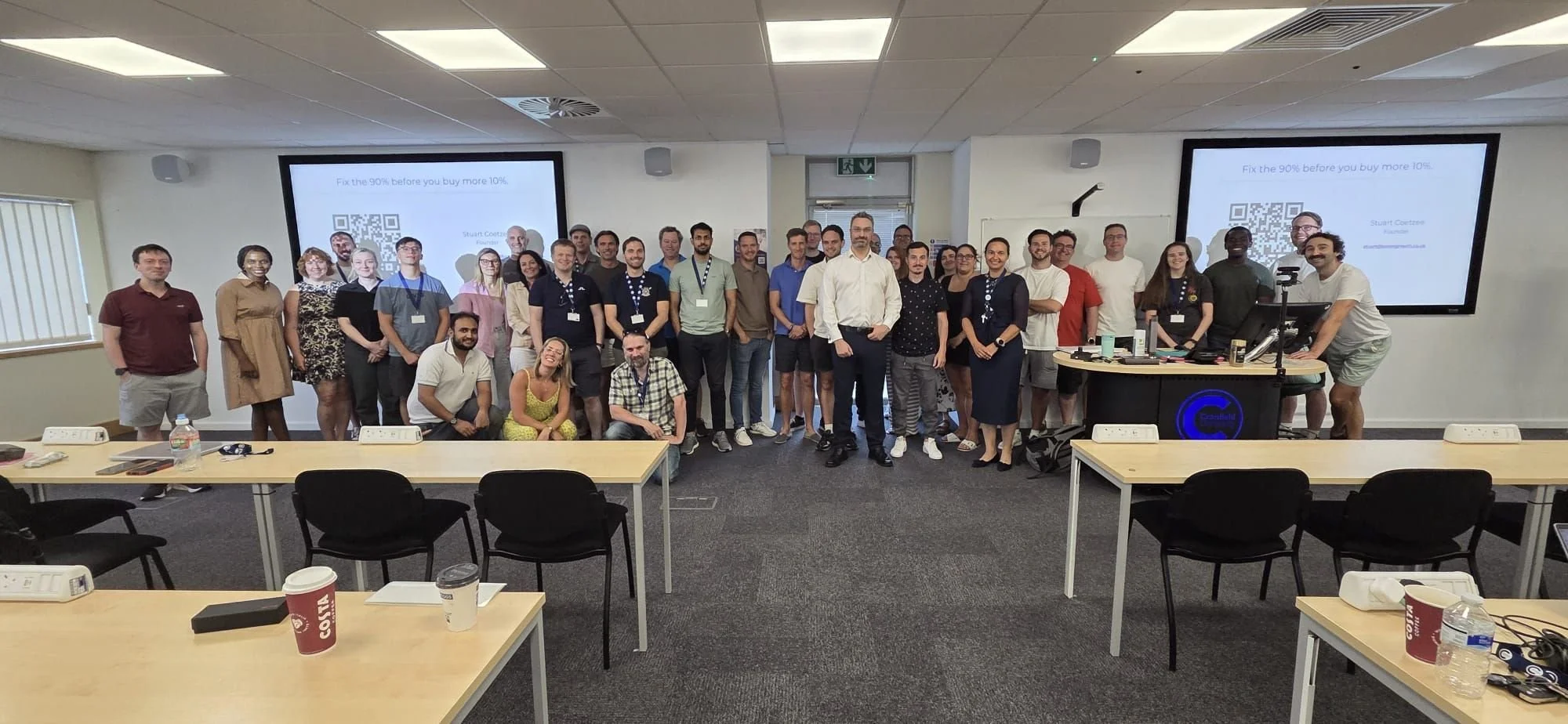
This observation resurfaced recently when Tenon Growth contributed a guest session on AI transformation to the Executive MBA programme at Cranfield School of Management, hosted by Dr Oksana Koryak.
The discussion quickly moved beyond AI software and tools.
Experienced executives wanted to talk about leadership, decision-making, organisational change and implementation.
The technology itself was only part of the conversation.
The more important question became:
Why do some organisations successfully embed AI while others struggle to move beyond isolated experiments?
The Organisational Capability Gap
The common explanation is that AI projects fail because the technology is immature.
In reality, today’s AI tools are remarkably capable.
What often holds organisations back is something far less visible.
They lack the organisational capability needed to adopt AI effectively.
Growing businesses rarely lack ambition.
More often, they lack the visibility, alignment and capability required to scale.
AI simply exposes those weaknesses more quickly.
As we often say at Tenon Growth:
AI does not fix broken systems. It makes them run faster.
The Tenon Growth Capability Framework
Our experience suggests that sustainable AI transformation rests on four connected layers.
Layer
Key Question
How AI Supports It
Visibility
Do we understand what is really happening?
Provides faster insight through better reporting, analytics and pattern recognition.
Alignment
Is everyone working towards the same objectives?
Improves collaboration, communication and decision-making.
Capability
Do we have the systems, workflows and skills to execute consistently?
Automates repetitive work and augments human judgement.
Sustainable Growth
Can improvements be repeated and scaled?
Accelerates organisations that already operate effectively.
Notice where AI sits.
It strengthens each layer.
It does not replace them.
Technology Amplifies the Organisation You Already Have
A useful way to think about AI transformation is this:
Around 10% is the technology itself.
Around 20% relates to processes and data.
Around 70% concerns people, leadership and organisational change.
These percentages are not scientific measurements. They are a practical model based on implementation experience.
However, they reflect a consistent reality.
Technology scales capability.
It can also scale dysfunction.
Buying AI is relatively easy.
Building an organisation capable of using it well is considerably harder.
What This Looks Like in Practice
Imagine two engineering businesses introducing AI-powered maintenance planning.
The first has inconsistent operational data, unclear ownership and fragmented reporting.
The AI produces recommendations, but engineers do not trust the information. Managers continue relying on spreadsheets. Adoption stalls and the expected return never materialises.
The second business begins somewhere different.
It standardises its operational data, clarifies ownership, redesigns workflows and agrees how success will be measured.
The same AI technology now delivers measurable improvements because it has been introduced into an organisation that is ready to use it.
The difference was never the software.
It was the organisation.
What Should Leaders Do Before Investing in AI?
Before purchasing another AI platform, ask seven simple questions.
What business problem are we actually trying to solve?
Do we fully understand the current workflow?
Can we trust the underlying data?
Are responsibilities and decision-making clearly defined?
Do our people understand how their work will change?
Will AI simplify an effective process, or simply automate existing confusion?
How will we measure whether the investment has genuinely created value?
If these questions are difficult to answer, another AI tool is unlikely to solve the problem.
AI Is an Accelerator, Not a Strategy
The excitement surrounding artificial intelligence is justified.
The technology will continue to reshape industries and create significant opportunities for organisations that adopt it well.
But AI is not a substitute for leadership.
It cannot create organisational clarity where none exists.
It cannot align priorities across teams.
It cannot redesign ineffective workflows.
It cannot build trust between departments.
Those remain fundamentally human responsibilities.
Research from organisations including McKinsey & Company, Microsoft and the World Economic Forum consistently shows that successful AI adoption depends as much on organisational readiness as technical capability. Businesses that redesign processes, improve data quality, develop skills and actively manage change are significantly more likely to realise lasting value than those that simply deploy new technology.
The question for leaders is no longer whether to adopt AI.
The real question is whether their organisation is ready to benefit from it.
Returning to the Banana
Looking back, the banana recognition project was never really about teaching a computer to identify fruit.
That turned out to be the straightforward part.
The harder challenge was helping organisations adapt their processes, behaviours and ways of working so the technology could create genuine business value.
That lesson has become even more relevant today.
The future of AI will not be determined by increasingly sophisticated algorithms alone.
It will be determined by the organisations that build the capability to use them well.
AI is not the organisational capability. It is an accelerator of the capability a business has already built.
About Tenon Growth
At Tenon Growth, we help ambitious SMEs improve commercial visibility, align teams, workflows and priorities, build the organisational capability required for sustainable growth, and apply AI where it creates measurable business value—not simply where it creates excitement.